I've used bubble wrap on windows for
two three+ years now, and I'm amazed how quick and easy it is. This year, we are
even covering the windows in the guest room -- we just take the bubble wrap down
when guests come, and put it back up when they leave -- 15 seconds a window.
This is a simple technique for
insulating windows with bubble wrap packing material. Bubble wrap is
often used to insulate greenhouse windows in the winter, but it also seems to
work fine for windows in the house. You can use it with or without
regular or insulating window shades. It also works for windows of
irregular shape, which can be difficult to find insulating shades for.
Its been five years since I
put this page up, and I've heard from MANY people who are quite happy
with using bubble wrap for window insulation.
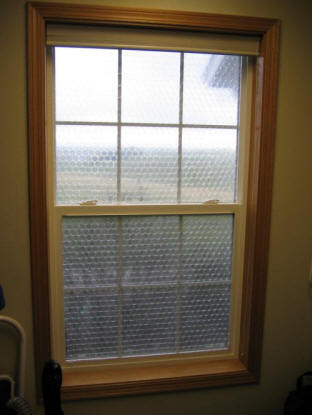
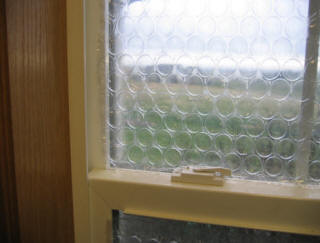
The view through the
bubble wrapped window is fuzzy, so don't use it on windows where you need a
clear view. But, it does let plenty of light through.
I like the medium to large size
bubbles. The larger ones appear (from surface temperature
measurements) to
insulate a little better, and you still get a nice artistic effect looking out
of them. The small bubble warp totally obscures the view, but you still
get light. Most people seem to prefer the large bubble version.
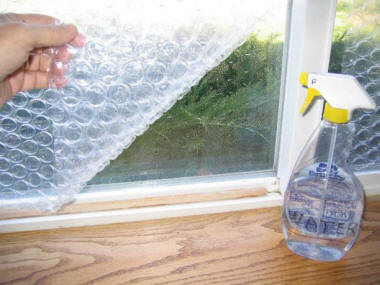
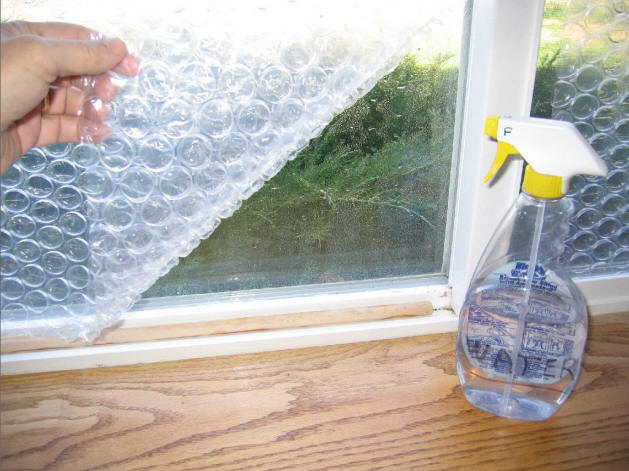
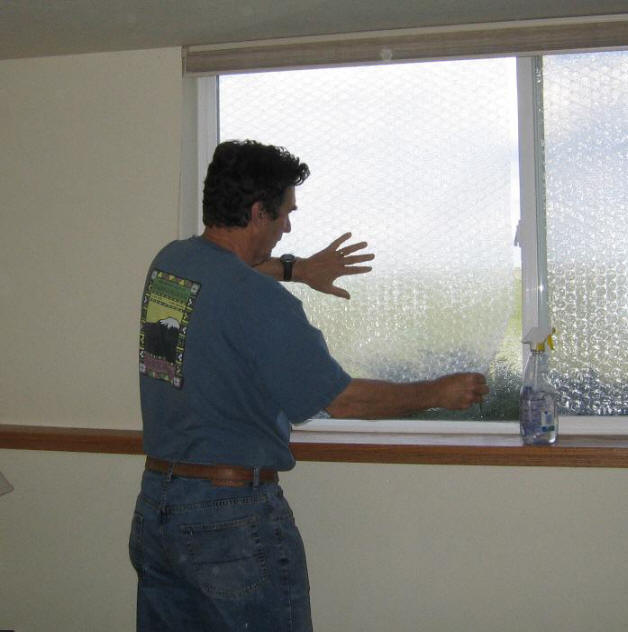
Cut the bubble wrap to the size of
the window pane with scissors.
Spray a film of water on the window
using a spray bottle.
Apply the bubble wrap while the
window is still wet and press it into place.
The bubble side goes toward the
glass.
To remove the bubble wrap, just
pull it off starting from a corner. You can save it and use it for
several years. It does not leave a mess or stains on the window glass.
If you have trouble with the bubble
wrap separating from the window when the film dries, you can try adding a little
Glycerin to the water, but this probably won't be necessary.
A few small pieces of double back
tape can be helpful on really stubborn windows.
The bubblewrap can be installed in the
fall, and removed in the spring. Judging by how mine looks after a year,
it may last quite a while.
When you take the bubble wrap down,
put a small number in on the upper right corner of each piece of bubble wrap,
and write down which window that number goes with on a piece of paper.
Save the paper for the installation next fall. This tells you instantly
where each sheet goes, and which way its oriented.
Some places to get bubble wrap:
- Save up bubble wrap packing
material that you and friends receive
- Check places that sell larger
items like canoes or furniture -- bubble wrap is often used for packing
these.
- Check for wholesale suppliers
of packing material in your area -- these places will often sell a roll to
the public.
- Here is one potential online
source:
http://www.uboxes.com (I've not actually tried them, but looks OK)
- As a last resort, places like
the UPS store have it, but the prices are usually high.
.
Suggestion from Pat: "Bubble wrap small bubble and large can be had for free by contacting
furniture retailers or rental shops. They throw it away by the tons!"
I've heard the same thing for places that sell canoes.
Spray water on glass with bubble side
toward glass
Smooth bubble wrap out so that water
contact holds it in place.
Double Bubble (added
Nov 15, 2007)
I thought it might be worth a try to
see if two layers of bubble wrap might be used.
This may be going a bit far, but it
does seem to work.
I applied a 2nd layer of bubble wrap
over the first layer in exactly the same way as the first layer was applied to
the window glass. That is, spray the first layer of bubble wrap with water
mist, and while its still wet apply the 2nd layer of bubble wrap to it and
smooth it out.
For both layers, the bubble side face the glass.
It has been a couple days since I did
this, and it is staying in place OK -- not sure if it will stay up with the
added weight in the long term or not.
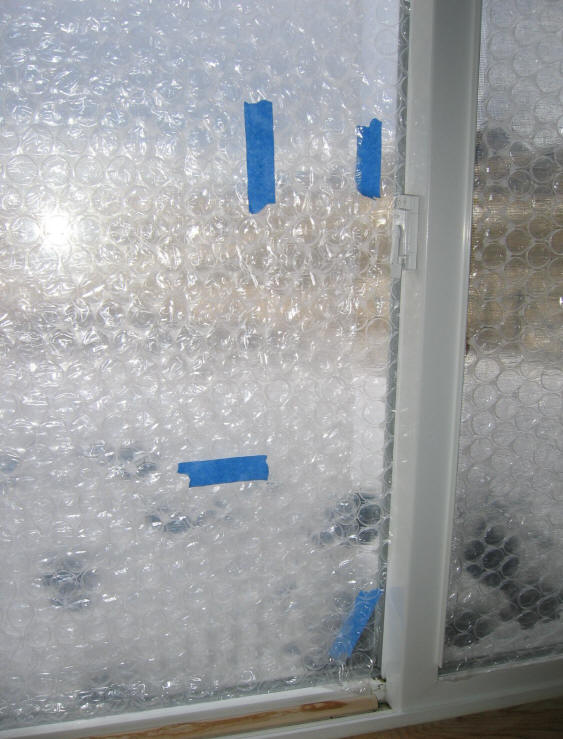
The two layers of bubble wrap fuzzy
the view a bit more than one layer, but it still seems to transmit quite a bit
of light.
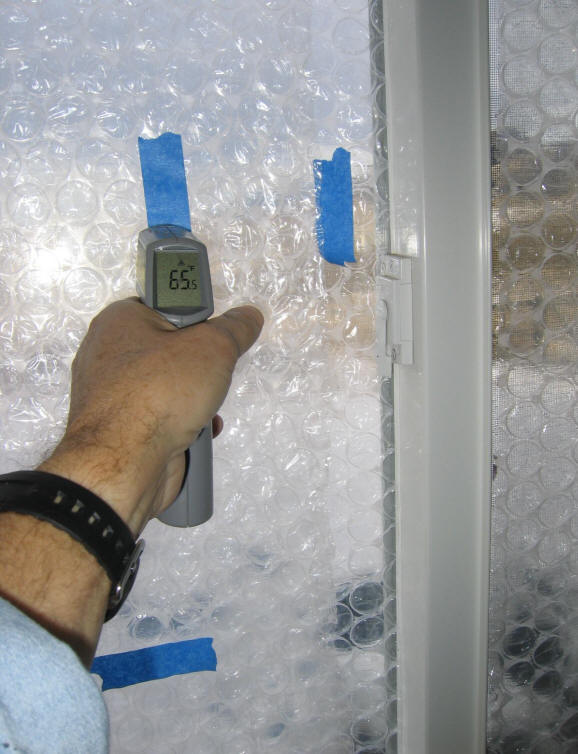
The surface temperature on the 2nd
layer is higher than the surface temperature on the first layer, so it is adding
some insulation value.
Click on images to enlarge.
View through single and doubled bubble wrap.
Blue tape is to take temperature readings on with the IR thermometer.
Payoff
The bubble wrap has a short payback in
cold climates. About 2 months for single glazed windows, and half a
heating season for double glazed widows. Details on payback:
For an 7000 deg-day climate (northern
US), and single glazed windows, the bubble wrap increases the R value from about
R1 to about R2. This cuts the heat loss from the window in half.
Heat losses with and without bubble wrap for 1 sqft of window are:
Heat loss w/o wrap
= (7000 deg-day)(1 ft^2) (24 hr/day) / (1 ft^2-F/BTU) = 168K BTU per season
Heat loss with
wrap = (7000 deg-day)(1 ft^2) (24 hr/day) / (2 ft^2-F/BTU) = 88K BTU per season
If you are heating with natural gas
at $1.50 per therm (100 CF) in an 80% efficient furnace, then the saving for 1 sqft of wrap
for the season is:
Saving per sqft =
($1.50)(168K - 88K)/(100K*0.8) = $1.65 per season per sqft of window
The bubble wrap cost about $0.30 per
sqft, so the payback period is about 2 months -- not too bad!
If you repeat the numbers above for
double glazed windows, the saving is $0.60 per sqft per season, and the payback
period is a about one half heating season.
If you use a more expensive fuel
like propane, fuel oil, or electricity, the savings will be correspondingly
more.
Some
interesting
work done by students at LIU on insulation value of packing materials.
Probably not exactly applicable to windows, but interesting.
Does Bubble Wrap Help In the Summer? (added March 2016)
There have been a few questions on whether bubble wrap is effective in reducing unwanted heat gain in the summer. The answer is that it does help some, but there are probably better approaches.
The bubble wrap adds insulation, so just as this added insulation helps to reduce heat loss from the warm room to the cold outside in the winter, it also helps to reduce heat gain from the hot outside to the cool room in the summer, and that is good and helps the room run cooler. But, heat gain also comes from the sun shining right through the window and the bubble wrap and then being absorbed when it hits a surface in the room. In the winter, this direct absorption of solar radiation is a good thing in that its free heat gain -- its one of the nice features of bubble wrap that it allows the sun to shine right through it and get beneficially absorbed in the room. But, in the summer this direct absorbtion of solar radiation in the room is a negative and its a big part of summer heat gain for windows that get a lot of direct sun.
For summer heat gain with windows that get direct sunlight its really important to prevent the sunlight from shinning through the window and into the room. The best way to do this is to stop the sunlight outside the window by shading the window on the outside in some way. The shading can be things like shade trees or bushes, shade screen (which still allows some light into the room, but blocks most of the heat gain), or completely opaque shades on the outside of the window that block all of the sun. If its not possible to shade the window on the outside, than another approach is to place a reflective surface (like a shade) just inside of the window with the reflective side facing the window. This reflects much of the sun right back out the window so it is not absorbed and converted to heat inside the room. Surfaces like aluminum foil or a reflective white paint are good at reflecting sunlight back out the window.
The section on passive cooling has a lot of ideas and schemes for reducing summer heat gain. The window shading page in particular has ways to reduce heat gain through windows.
Bubble Wrap Life:
Doug reports that bubble wrap that he
installed 6 years ago has about had it. He thinks the life is around 5 to 7
years. In his application, the bubble wrap stays up year round.
He reports that at the end of its
life, it tends to stick to the glass, so replacing it before this happens might
save some cleanup work.
The bubble wrap he is using was
intended for packaging, so this still leaves open the question of whether the
bubble wrap intended for greenhouses will last longer. The greenhouse
bubble wrap we installed is on its third winter, and is still doing fine.